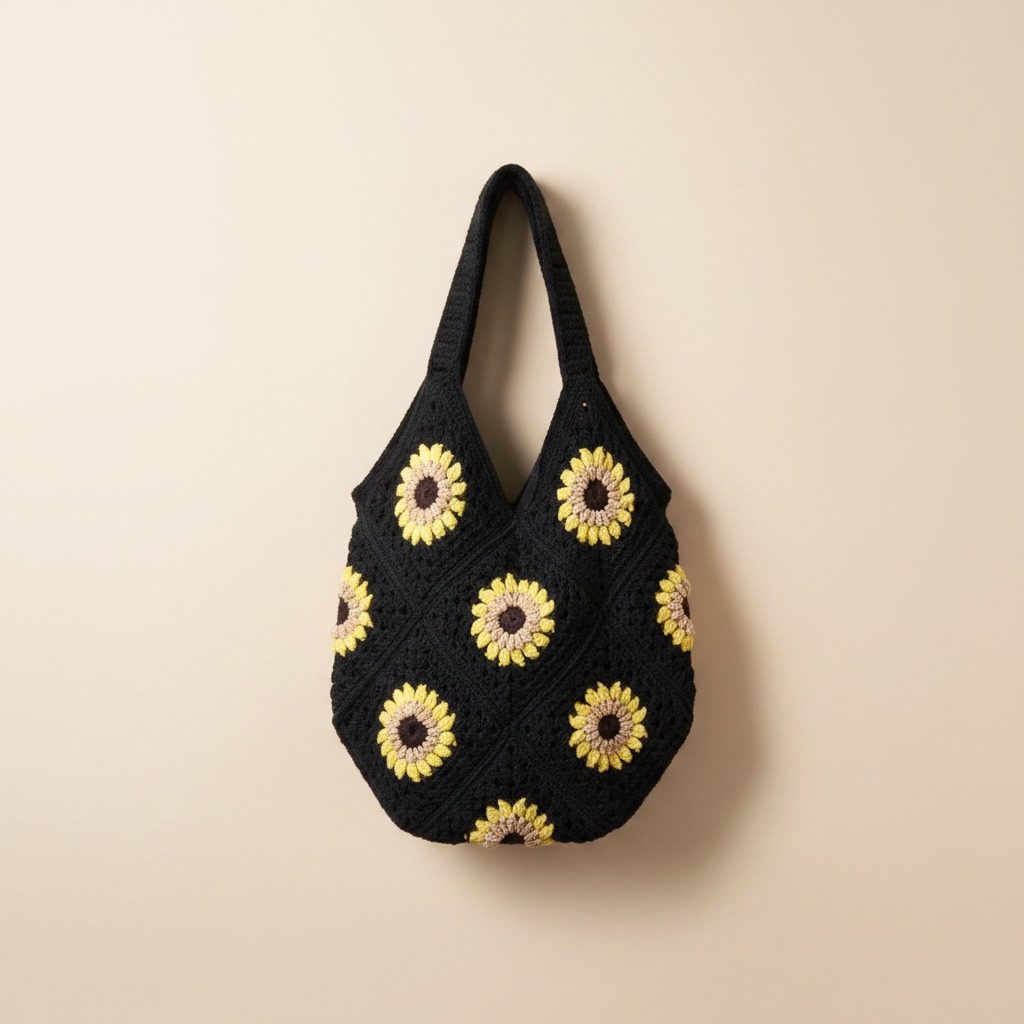
The granny square is the oldest crochet motif still in daily use anywhere in the world. Older than the amigurumi. Older than the doily. Older, in fact, than most of the words we now use to talk about crochet.
It survived because it is, on close inspection, an extremely intelligent object. Let me tell you what I mean.
It grows outward
Most crochet motifs are made in one direction — you start at the top and work down, or start at one end and work across. The granny square works from the centre outward, in rounds. This means you can stop at any round and have a finished object. Four rounds is a coaster. Twelve rounds is a placemat. Twenty-eight rounds is a blanket square. Sixty rounds is a shawl.
The granny square is the only crochet motif that does not have a fixed size.
This is unusual in textile work. A pattern is almost always a commitment to a size. The granny square is a commitment only to a colour and a rhythm.
It uses every scrap
You change colours every round if you like. Or every three rounds. Or never. This means the granny square is the historical workhorse for using up leftover yarn from other projects. My mother's blankets were made almost entirely from the ends of other people's sweaters. I still have one.
The scrap-yarn logic is why the granny square is associated with the 1970s in the West. When yarn was expensive and thrift was moral, the granny square was the honest answer.
It joins easily
Each square has four straight edges of equal length. This sounds obvious, but almost no other crochet motif has this property. Circles don't. Hexagons don't (well, hexagons do, but they leave gaps). Only the granny square can be laid out in a perfect grid, joined at the edges, and produce a flat blanket without a single gap or a single decrease.
This is why every crochet tote bag in the world is made of granny squares. The bag needs to be a rectangle. The granny square makes rectangles without having to be told to.
It looks handmade
It cannot be mistaken for a factory object. The little central hole, the visible stitches, the corners that catch the light — none of this can be replicated on a machine. Which means that when you carry a granny-square bag or wear a granny-square top, everyone who sees it knows a person made it.
The granny square is a small argument for the human hand.
This is why I put so many of them into the maison. The Sunflower Granny Crop Top, the Onyx Sunflower Tote, the Bluebell Daisy Tote, the Meadow Duo, the Sunflower Meadow Mat. Each one is a grid of small squares, each square a small commitment, each commitment paid off by the next.
And when you look closely, the little central hole in each square lets a bit of light through. This, too, is the oldest thing about it.