Rita begins her days the same way she has for forty years — with a cup of filter coffee, a small brass tin of hooks, and the light of the eastern window on her lap. The tin is her mother's. The hooks, she has replaced perhaps six times over the decades. The window has not changed.
She was a primary school teacher for thirty-two years. Retirement, she says, was not a stopping. It was a returning. Crochet had waited patiently on the sideboard through parent-teacher meetings and lesson plans and the raising of a son. When the classroom finally quieted, the yarn was still there.
"You cannot rush a stitch," she says. "You can only meet it."
Her atelier is a single room at the front of a house in south Bangalore. There are two chairs — the one she works in, and the one for whoever has stopped by that morning. There is a sideboard of skeins arranged by hue, not by weight. There is a small chair for the pieces in progress, so they may sit and wait.
The morning we visited, she was three-quarters through a set of Beanie Bunny Miniatures. Twelve small cream bodies laid out in a shallow cardboard box, four of them already in their little coloured hats. "The blue one goes to a doctor's daughter," she said, without looking up. "The rose is for a bride's niece. The rest go where they go."
She makes what she wants to make. What she wants to make, someone has always wanted to receive. This is, at heart, the whole method.
The morning routine
Coffee at six. The kitchen is quiet then. The dog is still asleep. She sits at the window for perhaps twenty minutes without doing anything, and this is not idle — it is when she chooses what to make. By the time she picks up the hook, the piece already exists in her mind.
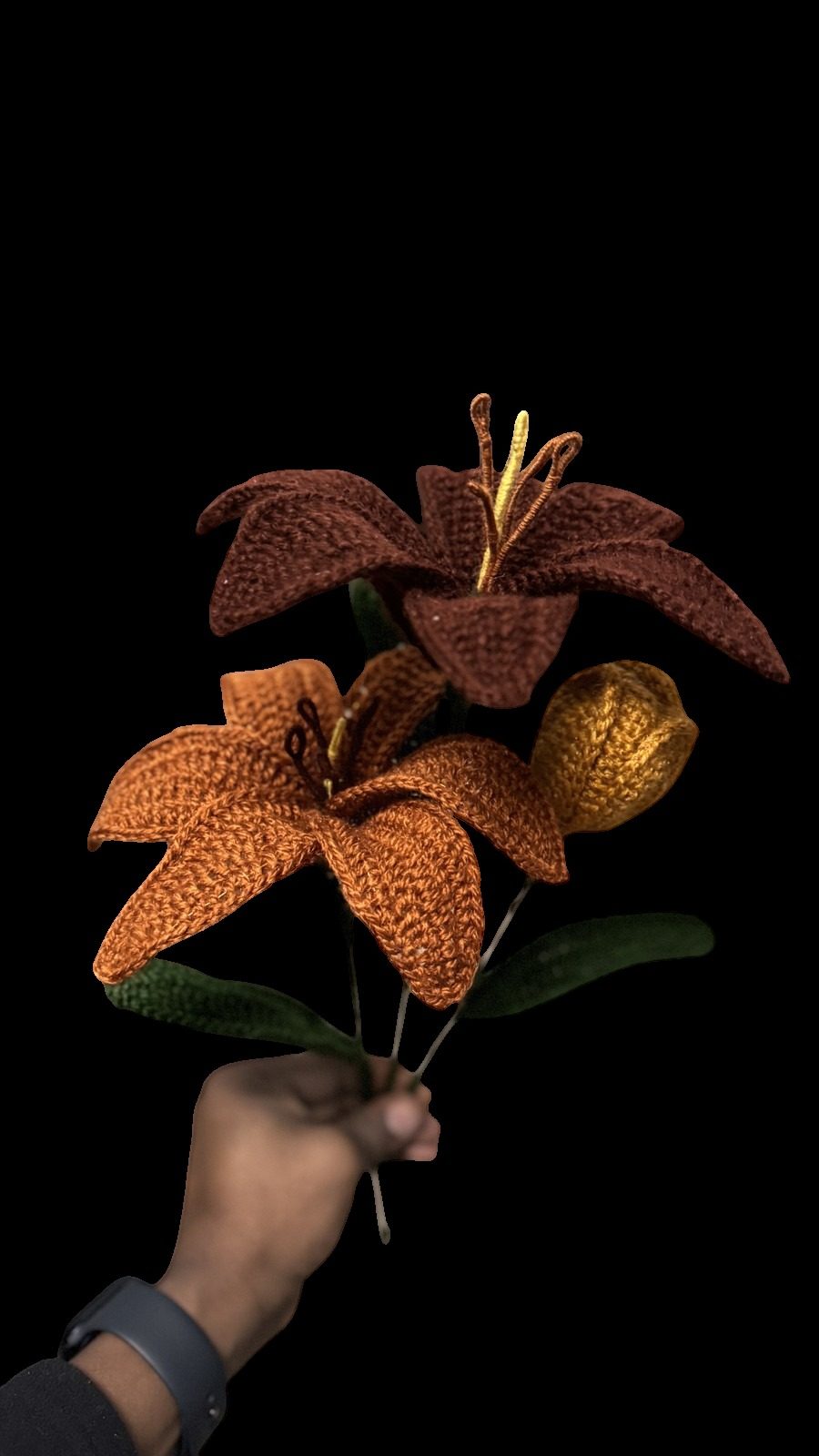
Then two hours of work. A break to stretch her hands. Another hour. The morning is the time for the pieces that need concentration — the amigurumi faces, the shaping of a lily's throat, the tension of a granny square that will be seen against skin. In the afternoon she does the simpler work — the stems, the leaves, the wrapping.
"Every piece is a small argument for slowness," she says.
By four o'clock, she is done. Whatever isn't finished can wait until morning. She has been at this long enough to know that the pieces made in the last tired hour are the ones she must redo. So she doesn't do them.
What she keeps and what she gives away
The atelier is not sentimental. She does not keep the first of any piece. When someone asks if she has a favourite, she gives an answer that sounds prepared until you realise she means it: "The one on the hook."